
Planting
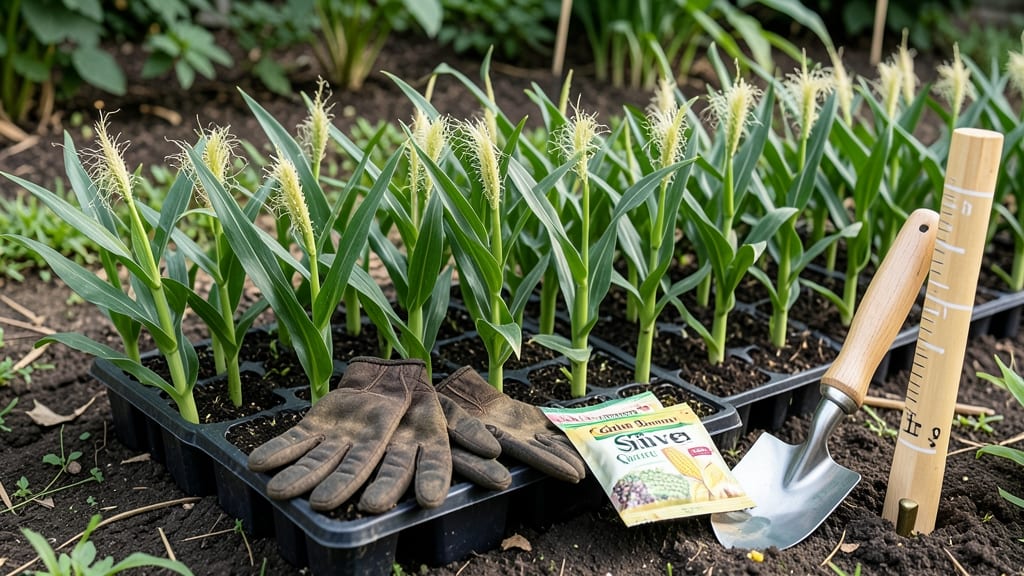
Sweet corn seed spacing determines whether you get a handful of ears or a towering harvest. 🌽 The secret to maximum yields isn't just planting seeds—it's placing them at the right distance for airflow, sunlight, and root growth.
My first corn patch yielded just 12 ears because I crammed seeds too close; now I follow these proven row distances that nearly doubled my harvest last summer.
Start with rows 30-36 inches apart—this gives plants room to lean toward sunlight without crowding. Within each row, space seeds 4-6 inches apart, then thin seedlings to 12 inches once they're knee-high.
For hills (common in home gardens), plant 4-5 seeds per mound, spaced 12-18 inches apart in all directions. The key is balance: too tight and you lose ears to disease; too wide and you waste space.
You'll know you've nailed it when plants stand tall with wide leaves that barely touch neighbors by pollination time. The ears form plump and sweet, not stunted from competition.
Even in tight spaces, this spacing works—just adjust row direction to catch morning sun. For clay soils, add compost to improve drainage; sandy soils need extra water during tasseling.
Common mistakes? Planting too deep (seeds need 1-1.5 inches of soil coverage) or ignoring wind direction (rows should run east-west for even sun exposure). Save yourself the guesswork: use a simple staking method with labeled strings to mark spacing before planting.
The payoff? A garden full of juicy, homegrown corn that tastes nothing like store-bought.
📚 In This Guide
- What you need
- Instructions
- Tips and common mistakes
- Wrapping up and next steps
What you need
- ● Sweet corn seeds: Choose high-quality, heirloom, or hybrid varieties (e.g., Bodacious, Silver Queen, or Peaches & Cream). Aim for 1–2 lbs per 100 feet of row, depending on your spacing goals.
- ● Garden soil: Well-draining, fertile loam with a pH of 6.0–6.8. Amend with compost if needed.
- ● Fertilizer: Balanced starter fertilizer (e.g., 10-10-10) at planting (follow package rates).
- ● Nitrogen-rich fertilizer (e.g., blood meal or 34-0-0) when plants reach knee-high (about 4–6 weeks after germination).
- ● Watering supplies: Hose with a gentle spray nozzle or drip irrigation system (to avoid disturbing seeds).
- ● Watering can with a fine rose attachment (for precision).
- ● Planting tools: Hand trowel or garden hoe for digging furrows.
- ● Measuring tape or spacer sticks (to maintain row distances).
- ○ Mulch: Straw, grass clippings, or black plastic mulch (optional but helps retain moisture and suppress weeds).
- ● Row markers: Stakes or flags to label varieties and spacing (e.g., 12", 15", or 18" apart).
- ● Trellis or stakes: For varieties that may need support (e.g., super sweet hybrids).
- ● Weed barrier cloth: To reduce manual weeding (especially in tight rows).
- ● Seedling heat mat: For early starts in cool climates (speeds up germination).
- ● Garden journal: To track planting dates, spacing, and yield results!
Step-by-step guide to perfect sweet corn seed spacing
Here's how I space sweet corn seeds for maximum yield—no guesswork, just proven distances that work in any garden layout.
🌱 Step 1: Plan Your Row Layout for Optimal Airflow
Sweet corn thrives when planted in blocks or wide rows, not single lines. Space your outer rows 24-36 inches apart—this creates a windbreak effect that stabilizes plants during storms and prevents ear rot from poor air circulation. I like to use a 36-inch spacing for most varieties, which gives me enough room to walk between rows for maintenance.
Mark your row locations with stakes or a garden twine stretched between them. This ensures you won't accidentally plant seeds too close to the edge of the row later. The wider spacing now prevents overcrowding as plants mature. Think of it like setting up a grid—each row will eventually support 3-4 plants per foot of length.
🌱 Step 2: Space Seeds Precisely Within Rows
Plant seeds 1 inch deep and 4-6 inches apart within each row. The exact spacing depends on your corn variety—dwarf varieties can go on the tighter end (4 inches), while standard sweet corn benefits from 6 inches. I use a 6-inch spacing for most varieties because it gives roots room to establish before the canopy closes.
Here's my trick: Use a seed spacing tool or even a small ruler to measure between seeds. If you're planting by hand, tap the seed packet gently to release one seed at a time—planting too many in one hole leads to weak, crowded plants that produce small ears. After planting, cover seeds with soil and gently firm it down with your fingers to ensure good seed-to-soil contact.
☀️ Step 3: Thin Seedlings for Maximum Yield
When seedlings reach 6-8 inches tall (about 3-4 weeks after planting), it's time to thin. Leave the strongest plant in each 12-inch section of row—this ensures each plant has enough nutrients and sunlight. You'll be removing seedlings, but this step is critical for ear development. Weak, crowded plants produce small, undersized ears.
Use sharp scissors or your fingers to snip seedlings at soil level rather than pulling them. This prevents disturbing the roots of remaining plants. If you're planting in blocks, thinning ensures 2-3 plants per square foot of space, which is ideal for most sweet corn varieties. Watch for first tassels—this is your signal that thinning is urgent, as plants will soon compete for resources.
💧 Step 4: Monitor Spacing as Plants Mature
As corn grows, the lower leaves will yellow and die back—this is normal. However, if you notice leaves rubbing against each other or ears touching, your spacing is too tight. At this stage, you can either prune lower leaves to improve airflow or thin further if needed. I usually prune instead of thinning, as it's less stressful for the plant.
Pay close attention to ear development—ears should be 6-8 inches long before harvest. If plants are too crowded, ears will be small and underdeveloped. The goal is to have 12-18 inches of space between mature plants in all directions. This ensures each ear gets enough sunlight and nutrients to reach full size. If you're growing multiple varieties, space them even further apart to prevent cross-pollination.
⏰ Step 5: Harvest at Peak Ripeness
Harvest sweet corn when silks turn brown and kernels are fully plump but still milky when pierced with a fingernail. Overripe corn turns starchy and loses sweetness. I like to harvest in the early morning when sugars are at their peak. Cut ears 1 inch above the cob with a sharp knife to avoid damaging the plant.
Proper spacing ensures you'll have large, well-filled ears ready for the table. If you've followed these steps, you should get 2-3 ears per plant, depending on the variety. After harvesting, save some seeds for next year or compost the stalks—just be sure to remove all plant debris to prevent pests and diseases from overwintering in your garden.
Tips & tricks for perfect sweet corn planting
These practical strategies will help you avoid common spacing mistakes and get the most out of your corn garden.
Row Layout Precision: When marking your 24-36 inch outer row spacing, use a measuring tape stretched between stakes for perfect alignment. I've found that using a 36-inch spacing creates ideal wind protection while still allowing easy access for weeding and maintenance. For larger gardens, consider using a laser level to ensure completely straight rows—this prevents uneven growth patterns down the line.
Seed Spacing Consistency: The 6-inch spacing within rows is crucial for mature plants to develop properly. I recommend using a seed spacing tool or even a small wooden dowel marked with your spacing measurements. This ensures every seed gets exactly the same amount of room to grow. For dwarf varieties, stick to the 4-inch spacing mentioned in Step 2—these compact plants can handle closer quarters without sacrificing yield.
Thinning Timing: Don't wait until you see tassels to thin! The 6-8 inch height mark is your best indicator for when to thin seedlings in 12-inch sections. I've learned the hard way that waiting too long leads to root disturbance when you finally do thin. Use sharp scissors to cut seedlings at soil level—this prevents uprooting the remaining plants and gives you cleaner cuts that heal faster.
Pro Tips for Sweet Corn Seed Spacing
- These practical strategies will help you avoid common spacing mistakes and get the most out of your corn garden.
- Row Layout Precision: When marking your 24-36 inch outer row spacing, use a measuring tape stretched between stakes for perfect alignment.
- Seed Spacing Consistency: The 6-inch spacing within rows is crucial for mature plants to develop properly.
Frequently asked questions
Got questions about sweet corn seed spacing? You’re not alone! Here are answers to the most common concerns—from planting precision to troubleshooting—so you can grow a bountiful harvest with confidence.
What’s the ideal distance between sweet corn seeds in a row?
For most sweet corn varieties, space seeds 1–2 inches apart within the row. Thin seedlings to 4–6 inches apart once they’re 4–6 inches tall. Wider spacing (6+ inches) improves airflow but may reduce yield per row. Check your seed packet for variety-specific recommendations!
How does seed spacing affect harvest timing?
Closer spacing (1–2 inches) speeds up canopy closure, shading out weeds and encouraging uniform maturity. Wider spacing (3+ inches) can delay ear development by 3–7 days but may improve ear size. For su-crimson or sugar-enhanced varieties, tighter spacing helps maintain sweetness longer.
Can I plant sweet corn seeds too close together?
Yes! Overcrowding leads to stunted growth, poor ear development, and disease risk (like fungal infections). If you accidentally plant too close, thin seedlings early—waiting too long stresses roots. Pro tip: Use a seed spacing tool or toothpick markers to avoid guesswork.
What if I don’t have enough space for proper spacing?
Try these space-saving tricks:
- Interplant with shallow-rooted crops like lettuce or radishes.
- Use bush varieties (e.g., ‘Silver Queen’ or ‘Peaches and Cream’), which grow shorter and yield ears closer to the stalk.
- Plant in containers (5+ gallon pots) with 2–3 seeds per pot, thinning to 1.
Why are my sweet corn plants uneven, even with correct spacing?
Uneven growth often stems from inconsistent soil moisture, poor soil fertility, or uneven germination. Test soil pH (aim for 6.0–6.8) and add compost. If seeds germinate unevenly, hand-thin aggressively, leaving the healthiest seedlings. For extra insurance, soak seeds in water for 12 hours before planting.
Does seed spacing change for organic vs. conventional growing?
No—but organic methods may require slightly wider spacing (4–5 inches) to accommodate hand-weeding and natural pest control (like companion planting with marigolds). Conventional growers can space closer (3–4 inches) with herbicides, but organic gardens benefit from better airflow to prevent disease.
Wrapping up and next steps
Perfecting your sweet corn seed spacing is the secret to a bountiful, flavorful harvest! 🌽 By following proven row distances—like 15-36 inches between plants and 30-36 inches between rows—you’ll maximize yields, reduce competition, and enjoy healthier stalks. Whether you’re a seasoned gardener or a beginner, these tips make success simple.
Now that you’re armed with the know-how, grab your seeds and get planting! 🌱 Track your progress, experiment with spacing, and soon you’ll be savoring homegrown corn straight from your garden. Happy growing!