
Propagation
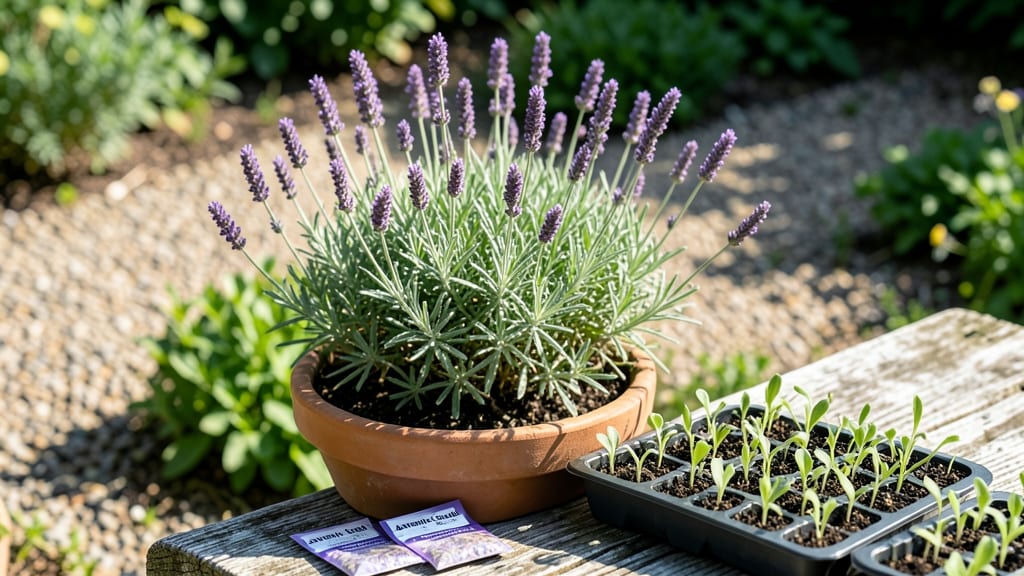
Growing lavender from seed takes 6 months to 2 years before flowering, with most varieties needing 12–18 months to reach maturity. The slow process stems from delayed germination, cold stratification requirements, and extended juvenile growth phases.
Lavender's long maturation timeline isn't just about patience—it's rooted in biology. 🌱 Unlike cuttings, which can flower in just 6–12 months, seeds require 30–90 days to germinate, often needing cold stratification to break dormancy.
Even after sprouting, lavender plants focus energy on root and leaf development before flowering, with some varieties like English lavender taking nearly twice as long as faster-growing types. The good news? Proper soil prep, consistent sunlight, and strategic planting in early spring can shave off 2–3 months from this timeline.
For impatient gardeners, choosing the right variety makes a big difference. Spanish lavender (Lavandula stoechas) tends to flower faster than French lavender (Lavandula dentata), while grosso lavender often matures more quickly than its English counterparts. 🌿 I recommend starting seeds indoors in late winter under grow lights, then transplanting outdoors after the last frost—this two-step process helps compensate for the natural delays.
Just remember: the wait is worth it when you finally see those purple blooms!
💡 In This Article
- Why Lavender Seeds Take So Long to Mature
- Speeding Up Lavender Growth: Variety-Specific Tips
Why lavender seeds take so long to mature
Lavender's slow growth from seed starts with its dormancy mechanisms. Unlike many annual flowers, lavender seeds often require cold stratification—a period of cold, moist conditions to break dormancy. This mimics the plant's natural cycle in Mediterranean climates, where seeds germinate after winter rains.
Without this step, germination can take 30–90 days or fail entirely. For example, English lavender (Lavandula angustifolia) seeds typically need 60–90 days of cold treatment before sprouting, while Spanish lavender (Lavandula stoechas) may only require 30–45 days. 🌱
The juvenile growth phase is another key factor. Once sprouted, lavender plants prioritize root and leaf development for 6–12 months before allocating energy to flowering.
This phase is critical for establishing a strong root system—lavender roots grow slowly but deeply, reaching 12–18 inches underground to access water in arid conditions. During this time, you'll notice small, narrow leaves and minimal height growth (often just 3–6 inches per year).
The plant's focus on survival over reproduction is what makes this stage so prolonged.
Genetic differences between varieties also play a role. For instance, grosso lavender (Lavandula × intermedia) hybrids often mature faster than pure English lavender because they inherit traits from both parent species, including larger leaves and thicker stems that accelerate growth.
Meanwhile, French lavender (Lavandula dentata) tends to be slower due to its finer foliage and smaller flower clusters. These variations mean your timeline can shift by 6–12 months depending on the type you choose.
Light exposure further influences maturation. Lavender is a sun-worshipper, requiring 6–8 hours of direct sunlight daily to thrive. In low-light conditions, plants grow leggy and weak, delaying flowering by 3–6 months.
Even after establishing roots, insufficient light triggers etoliation (stretched, pale growth), forcing the plant to redirect energy toward survival rather than blooming. This is why gardeners in northern climates often see slower progress compared to those in full-sun Mediterranean regions.
Soil conditions also impact the timeline. Lavender thrives in well-draining, alkaline soil (pH 6.5–7.5) with low organic matter. Heavy or clay soils cause root rot, stalling growth entirely. When planted in ideal conditions—sandy, gravelly soil with minimal fertilization—lavender focuses energy on flowering.
Over-fertilizing with nitrogen, for example, can delay blooming by up to 6 months by encouraging excessive leaf growth. The key is striking a balance: enough nutrients to support growth, but not so much that it smothers the plant's natural flowering cycle.
Finally, temperature fluctuations matter. Lavender is hardy to USDA zones 5–9, but it hates humidity. High moisture levels (especially in summer) can trigger fungal diseases like powdery mildew, which weakens the plant and postpones flowering.
In contrast, dry, warm summers (like those in Provence, France) accelerate maturation by creating ideal conditions for growth. This is why lavender grown in arid climates often flowers 6–12 months earlier than in damp regions.